









The rapid advancement of artificial intelligence has transformed the way people create, edit, and enhance visual content. From generating realistic artwork to improving image quality, AI-powered tools are making creative processes more accessible than ever. One of the most exciting innovations in this space is the AI tool to convert photo to 3D, a technology that allows users to transform ordinary 2D images into immersive three-dimensional models with remarkable accuracy.
Whether you are a digital artist, marketer, game developer, architect, or hobbyist, AI-driven 3D conversion tools are opening new opportunities for creativity and productivity. This article explores how these tools work, their benefits, practical applications, and what the future holds for AI-powered image generation and 3D visualization.
What Is an AI Tool to Convert Photo to 3D?
An AI tool to convert photo to 3D uses machine learning algorithms and computer vision technology to analyze a flat image and generate depth information. By understanding the shapes, textures, lighting, and perspective within a photograph, the AI creates a realistic three-dimensional representation of the original subject.
Traditionally, creating 3D models required specialized software, technical skills, and significant time investment. AI has dramatically simplified this process by automating many of the complex steps involved in 3D reconstruction.
Today, users can upload a single photograph and receive a detailed 3D model within minutes, making the technology accessible to both professionals and beginners.
How AI Converts Photos into 3D Models
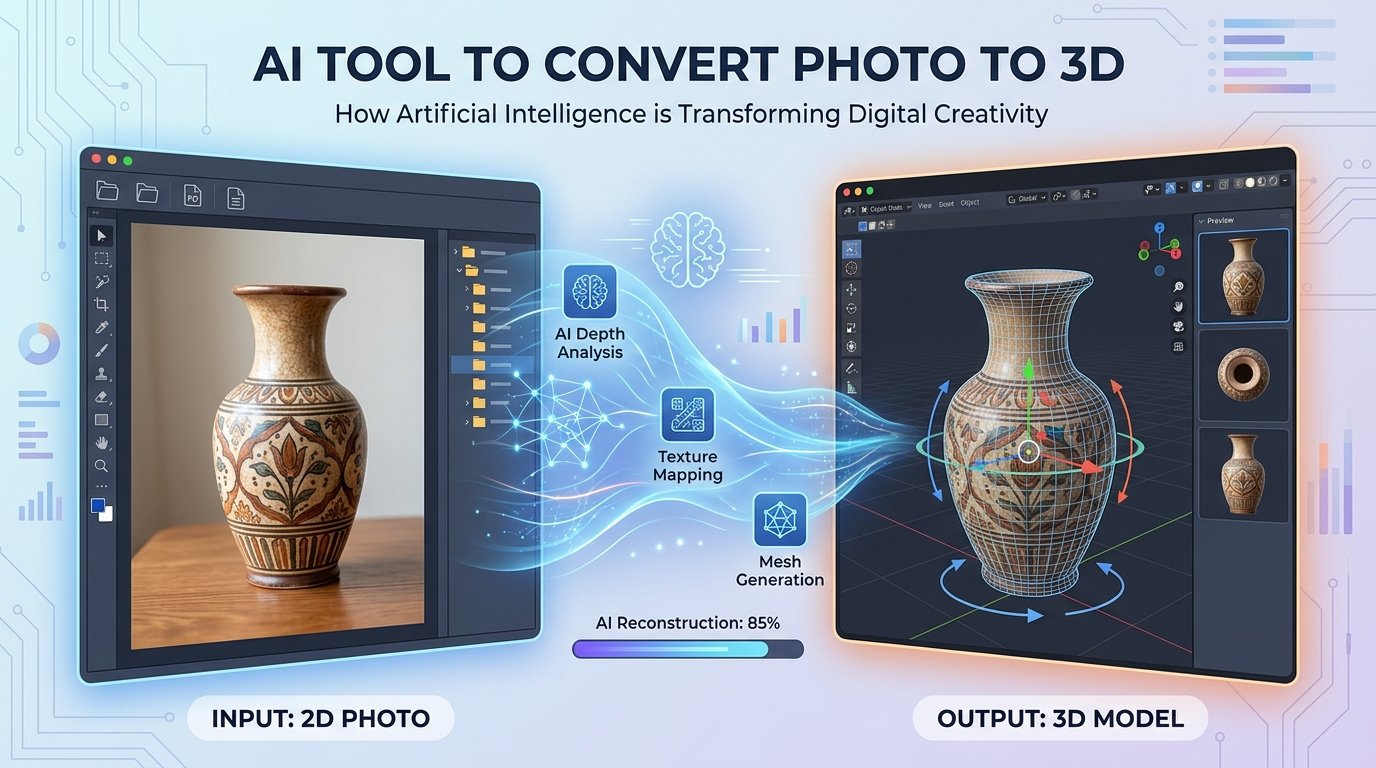
The process behind AI-powered 3D conversion involves several advanced technologies working together:
1. Image Analysis
The AI first examines the uploaded photograph to identify objects, edges, shadows, textures, and perspective cues.
2. Depth Estimation
Using trained neural networks, the system predicts the distance of different elements within the image from the viewer. This creates a depth map that serves as the foundation for the 3D model.
3. Surface Reconstruction
The software transforms the depth information into geometric structures, generating the shape and volume of the object.
4. Texture Mapping
Finally, the original image textures are applied to the 3D geometry, resulting in a realistic and visually appealing model.
This automated workflow allows users to generate complex 3D assets without extensive technical expertise.
Benefits of Using an AI Tool to Convert Photo to 3D
Faster Content Creation
One of the biggest advantages of AI-driven 3D conversion is speed. Tasks that once required hours or days can now be completed in minutes.
Reduced Technical Barriers
Traditional 3D modeling often demands advanced software knowledge. AI tools simplify the process, enabling more people to participate in digital content creation.
Cost Efficiency
Businesses and creators can reduce production costs by minimizing the need for manual modeling and specialized design resources.
Enhanced Creativity
AI allows creators to experiment with ideas quickly, helping them explore multiple design concepts without significant time investment.
Scalability
Organizations that need large volumes of visual assets can efficiently generate multiple 3D models from existing image libraries.
Industries Benefiting from AI-Powered 3D Conversion
E-Commerce
Online retailers use 3D product visualization to provide interactive shopping experiences. Customers can examine products from different angles before making a purchase.
Gaming
Game developers can accelerate asset creation by converting reference images into usable 3D objects.
Architecture and Real Estate
Architects and property marketers use AI-generated 3D models to create immersive visual presentations and virtual tours.
Education
Educational institutions utilize 3D visualization tools to improve learning experiences in science, engineering, history, and design.
Marketing and Advertising
Brands leverage AI-generated 3D content to create engaging campaigns that capture audience attention across digital platforms.
The Growing Role of AI in Digital Art
Artificial intelligence is reshaping digital art in numerous ways. Artists can now generate concept designs, enhance photographs, create stylized effects, and build immersive visual experiences more efficiently than ever before.
For creators exploring artistic transformations, tools that allow users to discover photo to oil painting effects have become increasingly popular. These solutions demonstrate how AI can bridge the gap between traditional artistic styles and modern digital workflows, giving users new ways to express creativity while preserving artistic authenticity.
As AI continues to evolve, the boundaries between photography, illustration, painting, and 3D design are becoming increasingly fluid.
Key Features to Look for in a 3D Conversion Tool
When selecting an AI-powered 3D image generator, consider the following features:
Accuracy
High-quality depth estimation and realistic geometry generation are essential for professional results.
Ease of Use
A user-friendly interface helps streamline the creative process and reduces learning curves.
Export Options
Look for tools that support common 3D file formats such as OBJ, FBX, STL, or GLTF.
Customization
Advanced editing capabilities allow users to refine generated models according to specific project requirements.
Processing Speed
Fast rendering times can significantly improve workflow efficiency, especially for commercial applications.
Challenges and Limitations
While AI-powered 3D conversion has made significant progress, there are still some limitations:
- Complex scenes may produce less accurate depth estimations.
- Occluded or hidden areas cannot always be reconstructed perfectly.
- Highly detailed objects may require additional manual refinement.
- Output quality can vary depending on image resolution and lighting conditions.
Despite these challenges, ongoing advancements in machine learning continue to improve the quality and reliability of AI-generated 3D content.
The Future of AI Image Generation and 3D Modeling
The future of AI-powered visual technology looks exceptionally promising. Emerging developments in generative AI, neural rendering, and spatial computing are expected to make 3D content creation even more accessible and realistic.
Future AI systems may be capable of generating fully interactive virtual environments from a handful of images, revolutionizing industries such as gaming, virtual reality, augmented reality, architecture, and digital commerce.
As hardware capabilities improve and AI models become more sophisticated, the line between real-world photography and digitally generated 3D experiences will continue to blur.
Conclusion
The rise of the AI tool to convert photo to 3D represents a major milestone in the evolution of digital creativity. By simplifying complex modeling processes, reducing production time, and expanding creative possibilities, AI is empowering creators across a wide range of industries.
From e-commerce and gaming to education and digital art, AI-driven 3D conversion technology is transforming how visual content is produced and experienced. As innovation continues, these tools will play an increasingly important role in shaping the future of creative workflows, making advanced 3D design accessible to a broader audience than ever before.